Cyberpunk Planet
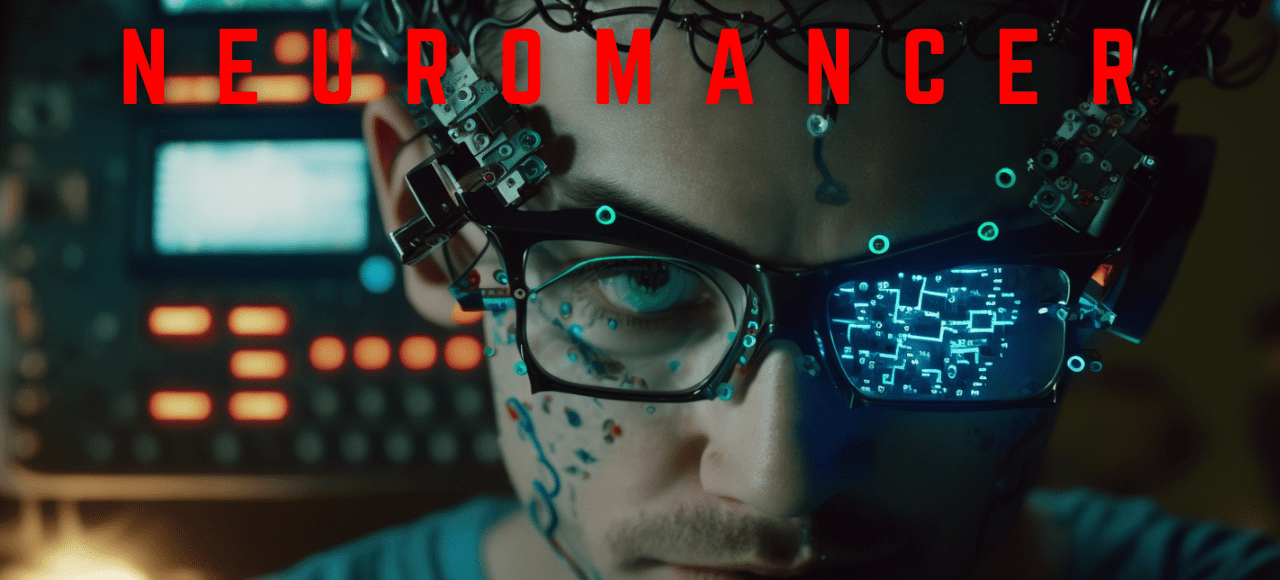
The sky above the port was the color of television, tuned to a dead channel...
- from “Neuromancer” by William Gibson
cyberpunk (sī′bər-pŭnk) - noun
1) A subgenre of science fiction which focuses on information technology, dystopian and virtual realities.
2) A cyberpunk character, a hacker punk, A high-tech low life.”
3) A writer of science fiction set in a lawless subculture of an oppressive society dominated by corporate powers & AI computer technologies.
Cyberpunk 1.0
The last quarter of the 20th century set the stage for the Brave Noö World we all have inherited. The socio-economic and para-political gyrations that came to fruition in the eighties and nineties laid the foundation for the 21st century’s autocratic turmoil. There were however, literary and cinematic indicators that provided fair warning...
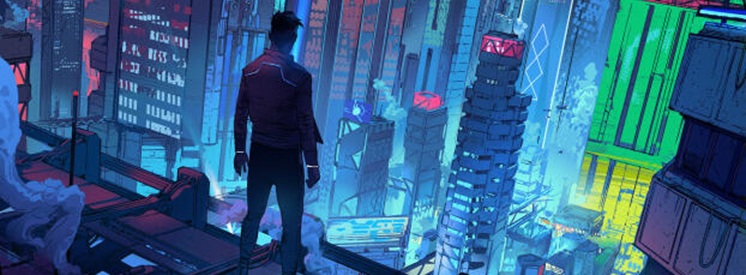
The close of the 20th century also provided us with a visionary and prophetic sub-genra of science fiction that came to be known as “Cyberpunk.” Cyberpunk’s dystopian themes of gritty cityscapes, climate collapse, unbridled corporatocracy and unleashed Artificial Intelligences, have proven especially prophetic in today’s dystopian reality.
Cyberpunk didn’t spring fully formed from the head of William Gibson like some chrome-plated Athena. Its DNA can be traced back to the noir-tinged science fiction of the 1960s and ’70s. Authors like Philip K. Dick were already exploring the dark underbelly of technological progress in novels like “Do Androids Dream of Electric Sheep?”
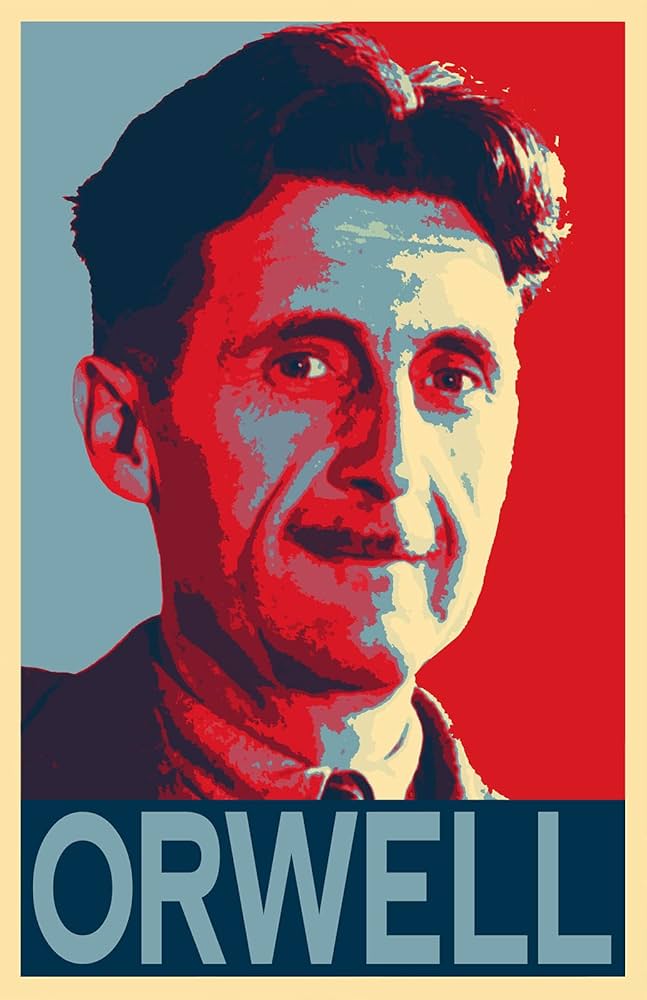
William Gibson first published his now-classic dystopian Science Fiction novel, “Neuromancer” in 1984. This year was a very prophetic and ominous year, especially for dystopian tomes, as it was the very year that another novelist, George Orwell… set as democracy’s expiration date, in his novel… Nineteen Eighty-Four.
“As literary political fiction and dystopian science-fiction, Nineteen Eighty-Four is a classic novel in content, plot, and style. Many of its terms and concepts, such as Big Brother, doublethink, thoughtcrime, Newspeak, Telescreen, 2 + 2 = 5, and memory hole, have entered everyday use since its publication” - Wikipedia.
Orwell’s work, published in 1949, was of course the granddaddy of all modern dystopian tales. Orwell’s novel, and its infamous character, the global party leader: “Big Brother” …reflected collective fears emerging from post-WWII, of... unbridled Nationalism, the rise of the Military-Inductrial Complex, censorship and mass surveillance. And of course, as in all good Sci Fi, Nineteen Eighty-Four served as a cautionary tale of an unpredictable, dangerous future.
Since its publication, “1984” has stood the test of time, to become the definitive work on dystopia. It continues to have relevance today, particularly for its examination of global government surveillance and the effect it visits upon the novel’s population.
Gibson’s Neuromancer has been credited for establishing “Cyberpunk” as a literary genre, and as being the archetypical cyberpunk novel. It appears that, like Orwell’s “1984,” Gibson’s “Neuromancer” is destined to become the definitive work on the new (and improved!) dystopian narrative.
Neuromancer explores a dystopic near future where a handful of powerful families, via their manifold mega-corporations, security firms, paramilitary and artificial intelligences, control the planet and its off-world stations. Neuromancer also presents the reader with the archetypical “console cowboy” or computer hacker... the quintessential cyberpunk, possessing singular talent and wondrous technologies. It is the cyberpunk, either alone or in legion, who wage virtual war against “the machine” or the machinations of the powerful predator/dominator elite.
Interestingly, cyberpunk is a word coined by Gardner Dozois, the science fiction writer and past editor of Asimov's Science Fiction magazine, to describe the fiction of William Gibson. The term went viral in the late 1980’s and early 1990’s, to become the definitive cultural icon of the emerging information age. The term has fallen in and out of favor in the twenty-first century, as being, now dated & clique... now, fearfully fitting & poignant.
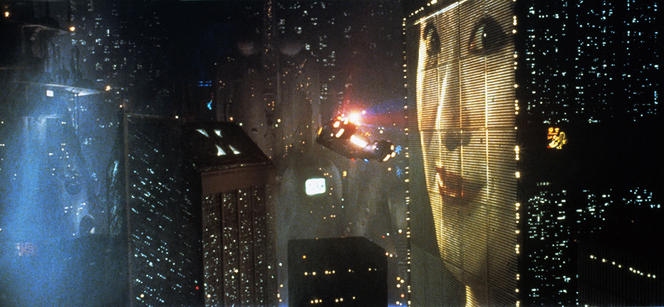
Two years prior to the publication of Neuromancer, a science fiction film directed by Ridley Scott, introduced world audiences to the visually stunning, proto-cyberpunk classic: Blade Runner. Starring Harrison Ford, Rutger Hauer, Sean Young, and Edward James Olmos, Blade Runner is an adaptation of Philip K. Dick's 1968 novel Do Androids Dream of Electric Sheep?
The film is set in a dystopian future (now past) Los Angeles of 2019, in which synthetic humans known as replicants are bio-engineered by the powerful Tyrell Corporation to work on space colonies. When a fugitive group of advanced replicants led by Roy Batty (played by Hauer) escapes back to Earth, former cop Rick Deckard (played by Ford) reluctantly agrees to hunt them down.
“Two years before Neuromancer, Blade Runner had already established the definitive visual aesthetic of cyberpunk cinema. The film’s depiction of a perpetually rain-soaked, neon-saturated, multicultural Los Angeles became the indelible image of the cyberpunk future. Its towering ziggurats, flying vehicles (“spinners”), and streets teeming with a polyglot humanity created a world that was both technologically advanced and deeply decayed.
This visual language was so powerful and pervasive that Gibson, upon seeing the film midway through writing Neuromancer, famously worried that audiences would assume he had simply copied its “fine visual texture”. While both works drew from a shared well of influences, including Métal Hurlant, Blade Runner provided the visual blueprint that would define the genre for decades.”
Cyberpunk 2.0
In a classic example of life imitating art, the next generation of cyberpunk has been exemplified by none-other than… Anonymous. The Anonymous Collective is a loosely associated international network of activist and hacktivist entities. Collectivly, they/it represent the first globally operational generation of cyberpunk. Established in 2003, Anonymous saught mass awareness and revolution against what the collective perceives as corrupt entities… while attempting to maintain anonymity.
This brief history of Anonymous was taken from Wikipedia…According to white supremacist radio host Hal Turner, in December 2006 and January 2007 individuals who identified themselves as Anonymous took Turner's website offline, costing him thousands of dollars in bandwidth bills. As a result, Turner sued 4chan, eBaum's World, 7chan, and other websites for copyright infringement. He lost his plea for an injunction, however, and failed to receive letters from the court, which caused the lawsuit to lapse.On January 14, 2008, a video produced by the Church of Scientology, featuring an interview with Tom Cruise was leaked to the Internet and uploaded to YouTube. The Church issued a copyright violation claim against YouTube requesting the removal of the video. In response to this, Anonymous formulated Project Chanology... calling the action by the Church of Scientology a form of Internet censorship.On January 21, 2008, individuals claiming to speak for Anonymous announced their goals and intentions via a video posted to YouTube entitled "Message to Scientology," and a press release declaring a "War on Scientology" against both the Church of Scientology and the Religious Technology Center. In the press release, the group states that the attacks against the Church of Scientology will continue in order to protect the right to freedom of speech, and end what they believe to be the financial exploitation of church members.On February 10, 2008, about 7000 people protested in more than 93 cities worldwide. Many protesters wore masks based on the character V from V for Vendetta (who, in turn, had been influenced by Guy Fawkes), or otherwise disguised their identities, in part to protect themselves from reprisals from the Church.It was these actions taken against the Church of Scientology that brought world-wide notoriety to Anonymous. In the ensuing years, Anonymous has ebbed and flowed in its recognition and effectiveness. However, it is its very amorphous nature that allows Anonymous to thrive in our contemporary, over-mediated information age. It is precisely this de-centralized, spontaneously plural disorganization that befuddles law enforcement, in their attempts to “neutralize” or for that matter, to even understand Anonymous.
How fast are you?
How dense?Cyberpunk is curious. Cyberpunk is tenacious. Cyberpunk is resilient. These are essential qualities of survival for the twenty-first century. The ability to retrieve (read: hack) and interpret (analyze) information is vital in navigating the modern world. It is in the interpretation of data that the cyberpunk’s survivability and opportunity resides. Deep thinking and the ability to “connect the dots” is what keeps the cyberpunk one step ahead of the machine.
This is where the true value of cyberpunk dwells... critical thinking and the ability to convey intricate and complex information in a concise format. This is the power of poetry… relating complex intellectual and emotional content in an articulate manner. Poetic imagery is dense. It imparts a lot of information, in few words.
What’s good about cyberpunk is that it’s fast and dense. It has a lot of information. If you value information the most, then you don’t care about convention. It’s not, “Who do you know?” …it’s “How fast are you? How dense?” It’s not, “Do you talk like my old friends?” …it’s “What do you have to say?” It’s not, “Is this comfortable?” …it’s “Is this interesting?”
Cyberpunk 3.0
...is poised to impact our world in a big way. Whether it will take the form of the ever re-spawning Anonymous Collective, or assume a new, as-yet unrecognized form… get ready. Cyberpunk is the response… the first line of defense… to the systems of control, the predator/dominator culture… the machine. The creativity and resilience of cyberpunk is quite likely the “agent of change” that will act as a catalyst of evolution. It may be that cyberpunk was “sent here” from from the future... from who knows where… to save our sorry ass.
…for Cyberpunk is also a changeling... a quick-change artist. Cyberpunk morphs as needed and stands upon the fulcrum point of societal change. The next generation of cyberpunk is about to hit the “execute” button. As we all know, change occurs at an exponential rate in our modern world. Change is the one constant in Universe... it is the one thing we can truly count on. And as we all know…
“In an evolving universe, he who stands still… moves backward.”
Pop Future
Home