|
|
“It
is known that there are an infinite number of worlds, simply
because there is an infinite amount of space for them. However, not every one of them is inhabited. Therefore,
there must be
a finite number of inhabited worlds.
Any
finite number divided by infinity is as near to nothing as
makes no odds,
so the average population of all the planets
in the Universe can be said to be zero.
From this it follows
that the population of the whole Universe is also zero,
and
that any people you may meet from time to time are merely
the products of a deranged imagination.”
-The
Hitchhiker's Guide to the Galaxy
|
Investigations into perceived
Extra-Terrestrial Phenomena
Encounters with
entities from other worlds/realities, has consistently been an
integral component of humanity's interaction with Universe.
Throughout recorded history, accounts of contact with Gods,
Angels, Demons, Star Beings, etc. are found in all cultures,
worldwide. Over time, human understanding of whom or what these
phenomena are… has evolved in sophistication.
The modern
era of Extra-terrestrial contact, began during World War II.
During the war, fighter pilots began filing reports of strange
flying balls of light that often accompanied allied and axis
fighter and bomber planes. These aberrations became known as “Foo
Fighters.” Although many strange lights have been reported
throughout history, the Foo Fighters of WW II and the subsequent
UFO/flying saucer phenomena of the 1950’s abruptly modernized
these ancient flying disc mythologies.
Hence, ancient
mythologies of “egrḗgoroi” or watchers, transform into alien
overlords. Old world “fairy folk” evolve into contemporary
mythologies of “grey aliens.” Small, green-clad leprechauns of
centuries past become almond-eyed, “little green men” of the
20th Century. Chariots of the Gods become flying saucers. The
boon of the captured leprechaun's pot of gold, transforms into
transistorized technological marvel, reverse-engineered from crashed saucers.
In the 21st
century, we have come to entertain a number of more exotically
compelling theories in what we call the postmodern phase of
thinking about the UAP (unidentified aerial phenomena) and/or
the UFO. Such theories take extra-terrestrial contact beyond a
physical handshake.
Contact may take
many forms, including but not limited to... physical, dreamtime,
psychic, trans-dimensional, psychedelic, archetypical,
symbiotic, etc. We at Tek-Gnostics like to keep our options
open, so although we favor a
Extra-Dimensional mythology, we assume all of the above are equally viable.
Find below a variety of third party links & connections to
further information, as well as other transmissions & excerpts on
this most intriguing topic...
Affiliated Transmissions
Transmissions from Beyond
|

Lexicon
Domain of knowledge -
glossary of terms @
Tek-Gnostics |
"If they
are not an advanced race from the future, are we dealing
instead with a parallel universe, another dimension where
there are other human races living, and where we may go at
our expense,never to return to the present? From that
mysterious universe, are higher beings projecting objects
that can materialize and dematerialize at will?"
"Are UFOs
windows rather than
objects?"
- Jacques Vallée
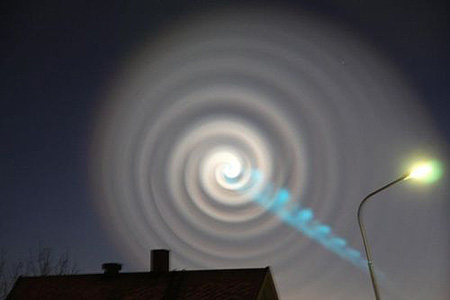
Norwegian Spiral Anomaly,
circa: 2009 |
Item: Extra-Dimensional Hypothesis
Extra-Dimensional
Hypothesis (or inter-dimensional hypothesis) is an
idea advanced by Ufologists such as Jacques Vallée,
suggesting that unidentified flying objects (UFOs)
and related phenomena involve visitations from other
realities or dimensions, as opposed to distant star
systems within our galaxy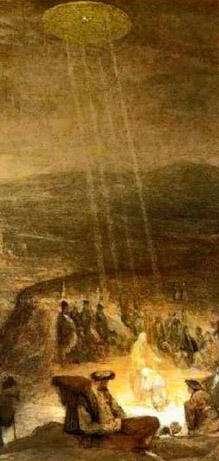 .
These separate realities coexist (relatively)
independent of our "indigenous" reality, yet are
extra-dimensionally interlaced with our local reality.
Visitors from such other realities, may possess the
ability to travel dimensionally versus spatially to our
indigenous reality. The Extra-Dimensional Hypothesis (EDH)
is an alternative to the Extra-terrestrial
Hypothesis. .
These separate realities coexist (relatively)
independent of our "indigenous" reality, yet are
extra-dimensionally interlaced with our local reality.
Visitors from such other realities, may possess the
ability to travel dimensionally versus spatially to our
indigenous reality. The Extra-Dimensional Hypothesis (EDH)
is an alternative to the Extra-terrestrial
Hypothesis.
Many
UFO proponents have accepted EDH because the vast
distance between stars makes interstellar travel highly
improbable using conventional means. Given our temporal
constraints... and absent any viable faster-than-light
hypothesis... travel between stars utilizing a
metal-hulled spacecraft appears to be, from our current
technological perspective, an insurmountable obstacle.
Within the EDH, it is not requisite to explain any
interstellar propulsion method, as it holds that UFOs
are not necessarily spacecraft, but rather
Extra-Dimensional-Craft, or devices that travel
between different realities.
One
advantage of this hypothesis, as proffered by
Hilary Evans,
is that it conveniently explains the apparent ability of
UFOs to appear and disappear from sight and radar, as
reported by a myriad of witnesses, including military and
air force personnel. This phenomena is explained as the
perceived UFO (Extra-Dimensional-Craft) entering and
leaving (materializing and dematerializing) our local
dimension. Moreover, Evans argues that if the other
dimension is slightly more advanced than ours, or is our own
future, this would explain the UFOs' tendency to represent
near future technologies (airships in the 1890s, rockets and
supersonic travel in the 1940s, etc.).
The
Extra-Dimensional Hypothesis also holds that UFOs are a
modern manifestation of a phenomenon that has occurred
throughout recorded human history, which in prior ages
were ascribed to mythological or supernatural events or
creatures...
"We are dealing with a yet
unrecognized level of consciousness, independent of man but
closely linked to the earth.... I do not believe anymore that
UFOs are simply the spacecraft of some race of extraterrestrial
visitors. This notion is too simplistic to explain their
appearance, the frequency of their manifestations through
recorded history, and the structure of the information exchanged
with them during contact."
Item: The mushroom speaks:
And our opinions rest
upon what it tells eloquently of itself in the cool night of the mind...
"I am old, older than thought in your
species, which is itself fifty times older than your history. Though I have been
on earth for ages I am from the stars. My home is no one planet, for many worlds
scattered through the shining disc of the galaxy have conditions which allow my
spores an opportunity for life.
The mushroom which you see is the part of my
body given to sex thrills and sun bathing, my true body is a fine network of
fibers growing through the soil. These networks may cover acres and may have far
more connections that the number in a human brain. My mycelial network is nearly
immortal, only the sudden toxification of a planet or the explosion of its
parent star can wipe me out.
By means impossible to explain because of certain
misconceptions in your model of reality all my mycelial networks in the galaxy
are in hyperlight communication across space and time. The mycelial body is as
fragile as a spider's web but the collective hypermind and memory is a vast
historical archive of the career of evolving intelligence on many worlds in our
spiral star swarm
Space, you see, is a vast ocean to those hardy life forms
that have the ability to reproduce from spores, for spores are covered with the
hardest organic substance known. Across the aeons of time and space
 drift many
spore-forming life-forms in suspended animation for millions of years until
contact is made with a suitable environment. drift many
spore-forming life-forms in suspended animation for millions of years until
contact is made with a suitable environment.
Few such species are minded, only
myself and my recently evolved near relatives have achieved the
hyper-communication mode and memory capacity that makes us leading members in
the community of galactic intelligence.
How the hyper-communication mode operates
is a secret which will not be lightly given to man. But the means should be
obvious: it is the occurrence of psilocybin and psilocin in the biosynthetic
pathways of my living body that opens for me and my symbiots the vision screens
to many worlds. You as an individual and man as a species are on the brink of
the formation of a symbiotic relationship with my genetic material that will
eventually carry humanity and earth into the galactic mainstream of the higher
civilizations.
Since it
is not easy for you to recognize other varieties of
intelligence around you, your most advanced theories of
politics and society have advanced only as far as the
notion of collectivism. But beyond the cohesion of the
members of a
species into a single social organism there lie richer and even more baroque
evolutionary possibilities. Symbiosis is one of these.
Symbiosis is a relation
of mutual dependence and positive benefits for both of the species involved.
Symbiotic relationships between myself and civilized forms of higher animals
have been established many times and in many places throughout the long ages of
my development. These relationships have been mutually useful; within my memory
is the knowledge of hyper-light drive ships and how to build them. I will trade
this knowledge for a free ticket to new worlds around suns younger and more
stable than your own. To secure an eternal existence down the long river of
cosmic time I again and again offer this agreement to higher beings and thereby
have spread throughout the galaxy over the long millennia.
A mycelial network
has no organs to move the world, no hands; but higher animals with manipulative
abilities can become partners with the star knowledge within me and if they act
in good faith, return both themselves and their humble mushroom teacher to the
million worlds all citizens of our starswarm are heir to."
From: Psilocybin - Magic Mushroom Grower's Guide
by
O.T. Oss &
O.N. Oeric
|