Is
Enlightenment the normal state for space-faring humans? As we find our collective footing in the 21st
century, humanity looks to the stars... poised at the edge of Earth’s gravity
well... in contemplation of leaving the nest. Despite 20th
century set-backs in the National Aeronautics and Space
Administration's (NASA) ability to deliver human payloads into
space (with the retirement of the shuttle program), human
presence in space has never been more imminent. The jump from a
terrestrial to extra-terrestrial species began with Galileo’s
telescope. As our understanding of universe grew, so did our
expectations... Before manifestation… imagination.
Over a century ago, in popular fiction, Flash
Gordon, Buck Rodgers et al, were humanity’s first, fanciful
space explorers. The Union of Soviet Socialist Republics’ (USSR)
spectacular launch of
Sputnik 1 on October 4, 1957... marked humanity’s
transition from fiction to fact. It marked humanity's serious entry
into an era that was to become known as the space age.
The 20th century space age was driven by the two competing,
cold war super-powers, the USA v USSR. This nationalistic
aggression was labeled the space race by 20th century
media.
In the 21st century, the most compelling advancement in
off-world activity comes from the development of a fledgling
commercial space industry. Unlike the space race of the 1960’s, the new, space race 2.0 is
being run between billionaires. NASA's Ansari X Prize
competition was set up to help jump start private spaceflight, which
was won by
Space Ship One in 2004.
In
2012, the Space Exploration Technologies Corporation's (SpaceX)
Dragon spacecraft made history when it became the first commercial
spacecraft in history to deliver cargo to the
International Space
Station and safely return cargo to Earth, a feat previously achieved
only by government space programs.
With the rise of
billionaire-funded, commercial space programs, we appear to be
witnessing the dawn of the
Great Houses of Old Earth, as fictionally depicted in Frank
Herbert's
Dune universe. Sir Richard Branson's:
Virgin
Galactic, Amazon founder Jeff Bezos’ aerospace and
sub-orbital spaceflight services company:
Blue
Origin, and last but not least, Elon Musk's
SpaceX... make
up the three, Oligarchic
forerunners of our fledgling, commercial space fleet. These
three
American Archons, for better or worse, champion humanity as
a space-faring civilization.
Recently,
Musk unveiled an ambitious plan to develop an
interplanetary rocket and capsule designed to move roughly 100
people and their cargo to the planet Mars. This intriguing prospect
of civilian space exploration, potentially opens up the experience of spaceflight
to a broader world community. More importantly, the expansion of opportunity also effectively
removes space exploration from the exclusive control of any single
governmental program or agency.
As
humanity takes the leap into the
heavens... the ingenuity, diversity and creativity of a broader cross
section of the human population, exponentially increases the evolutionary
possibilities available to us as a space-faring species.
In contemplating the
myriad implications of space flight, one intriguing evolutionary
dynamic is the advancement of human
consciousness. How will our awareness of self and universe evolve as
we migrate (and mutate) off-world?
Clues
can be found in our past, among the great light-bringers of
humanity. Profound thinkers such as Lao Tzu and Siddhartha
Gautama Buddha, who experienced and communicated enlightenment, can be
considered the template or prototype for humanity’s future
consciousness mode. The experiences of these precursors will become
the operational consciousness of space-faring humanity. The
triggering event for this
consciousness shift is the transition from
earth-bound existence to extra-terrestrial existence.
To
illustrate this, consider the following…
The Overview Effect In February, 1971, Apollo 14 astronaut
Edgar Mitchell
(9/17/1930 to 2/45/2016) experienced the
little understood phenomenon sometimes called the “Overview Effect”.
He describes being completely engulfed by a profound sense of
universal connectedness. Without warning, a feeing of bliss,
timelessness, and connectedness began to overwhelm him. He describes
becoming instantly and profoundly aware that each of his constituent
atoms were connected to the fragile planet he saw in the window and
to every other atom in the Universe. He described experiencing an
intense awareness that Earth, with its humans, other animal species,
and systems were all one synergistic whole. He says the feeling that
rushed over him was a sense of interconnected euphoria. He was not
the first - nor the last - to experience this strange “cosmic
connection”.
Rusty Schweikart experienced it on March
6th 1969 during a spacewalk outside his Apollo 9 vehicle: “When you
go around the Earth in an hour and a half, you begin to recognize
that your identity is with that whole thing. That makes a change…it
comes through to you so powerfully that you’re the sensing element
for Man.” Schweikart, similar to what Mitchell experienced,
describes intuitively sensing that everything is profoundly
connected.
Their experiences, along with dozens of
other similar experiences described by other astronauts, intrigue
scientists who study the brain. This “Overview
Effect”, or acute awareness of all
matter as synergistically connected, sounds somewhat similar to
certain religious experiences described by Buddhist monks, for
example. Where does it come from and why?
Andy Newberg, a neuroscientist/physician
with a background in space medicine, is learning how to identify the
markers of someone who has experienced space travel. He says there
is a palpable difference in someone who has been in space, and he
wants to know why. Newberg specializes in finding the neurological
markers of brains in states of altered consciousness: Praying nuns,
transcendental mediators, and others in focused or "transcendent"
states.
Newberg can actually pinpoint regions in subjects' gray matter that
correlate to these circumstances, and now he plans to use his
expertise to find how and why the Overview Effect occurs. He is
setting up advanced neurological scanning instruments that can head
into space to study--live--the brain functions of space travelers.
If this Overview Effect is a real, physiological phenomenon—he wants
to watch it unfold.
Newberg's first test subject will not be an astronaut, but rather a
civilian. Reda Andersen will be leaving the planet with Rocketplane
Kistler. She says, that as one of the world's first civilian space
adventurers, she is more than happy to let Andy scan her brain if it
can help unlock the mystery. Why do astronauts all seem to
experience a profound alteration of their perceptions when entering
space, and will it happen for Rita and the other civilian explorers
as well?
After decades of study and contemplation
about his experience, Ed Mitchell believes that the feeling of
oneness with the Universe that he and others have experienced is a
consequence of little understood quantum physics.
In a recent interview with writer Diana
DeRegnier of American Chronicle, Mitchell explains how the event
changed his life and his entire perspective on the world and how
each of us fits into the grand scale of the cosmos...
“Four hundred years ago, the philosopher
Rene Descartes came to the conclusion that physicality,
spirituality, mind and body belonged to different realms of reality
that didn't interact. Now, that served the purpose to get the
Inquisition off the
backs of the intellectuals so they could
disagree on material things with the church and without the fear of
being burned at the stake. So that ended that, but it did cause, for
four hundred years, science to consider consciousness and mind a
subject for philosophy and religion and not a subject for science.
Now, one of the things that happened, in
the 1940s, was the mathematician, physicist, Norbert Wiener (MIT,
Massachusetts Institute of Technology) for the first time really
defined information as the negative of entropy, and entropy as the
idea of the universe is running down and wastes energy. But, Wiener
defined information as the negative of entropy, and that's wonderful
but it didn't go far enough.”
Mitchell says that in an attempt to fill
in some of the missing gap, the 2008 revised edition of his book The
Way of the Explorer explores the largely ignored science of human
consciousness. Using what he calls the dyadic model he outlines
the two faces of energy. 'Instead of being two separate things,
it's the energy as the basis of our existence in matter. And, it’s
the basis of our knowing and information,' Mitchell explains.
'We had not had, in science, a
definition of consciousness. The only definition of consciousness
from the dictionary is that at its basic level it is awareness.
Consciousness means to be aware, and then we have different levels
of consciousness depending upon how complex the substance is. It has
been demonstrated many times over in laboratories that basic
awareness is demonstrable at the level of plants, at simple
bacteria, at simple life forms.
This is done with Faraday cages. It's
shown that this information at this deep level, at the quantum
level, can transcend electromagnetic theory. And, now we're getting
into quantum physics and we don't want to go there at this point.
But it's a very fundamental notion that awareness is at the very
basis of things.'
Mitchell believes that perhaps both the
theologians and scientists have missed the mark.
'All I can suggest to the mystic and the
theologian is that our gods have been too small; they fill the
universe. And to the scientist all I can say is that the gods do
exist; they are the eternal, connected, and aware… self-experienced
by all intelligent beings.'
In response to DeRegnier questioning
whether or not Mitchell believes in the idea of God, he responds
that while he does not believe in the traditional “randfather
figure version of God, 'we do have great mystery about what is the
origin of the universe, how it came to be. There's a great deal of
question as to whether the big bang is the correct answer to the way
the universe arose, and under what auspices and conditions. I don't
think we have the full answers to that yet. Hopefully in due course
we'll be able to find a much better way to describe all this.'
But while Mitchell does not claim to
know how to perfectly interpret his experience, he is certain that
it was a glimpse into a largely ignored reality: People, places and
things are all more closely connected than they sometimes appear. He
also mentions the need for better stewardship of our precious
planet."
- taken from a post at The Daily Galaxy by Rebecca
Sato)
The great thinker
Buckminster Fuller, philosopher, now deceased but for a goodly
portion of the twentieth century, pointed out at the beginning of
our space exploration that we are the crew of ‘space ship earth’.
But we're a crew of mutiny and how can you run a space ship with a
mutinous crew?
Satori… the new norm As our transition from an earth-bound existence to an
extra-terrestrial existence unfolds, our everyday consciousness
takes on characteristics of the “Overview Effect”, as described in
the above referenced article. In addition, as stated earlier, the
forerunners of our consciousness shift have provided us with a
template as to what to anticipate. Putting a more elegant name to
our newly expanded consciousness capability, we turn to
the Zen
Buddhist expression:
Satori. The word Satori defined
literally
means "understanding". Satori translates into a flash of sudden
awareness, or individual Enlightenment. Satori can be thought of as
an intuitive experience, as well.
Deepening awareness and
intuition are at the core of what it means to be truly human. Satori,
first experienced by the few extraordinary earthlings, increasingly
becomes who we all are. The beauty of our expanded human capacity is
that one doesn’t need to “live in space” in order to reap the
benefit of Satori consciousness.
As more of humanity awakens, we
approach a threshold of critical mass. That is to say, once we
achieve a cosmic tipping point, the rest of
us “go along for the ride.” What was once the enlightened few,
now
becomes the noö human norm.
The transition to an extra-terrestrial
existence will take time and may not proceed in a straight line of
progress. As in all great endeavors, there may be setbacks and
growing pains. We as a species must welcome the challenges and be
patient with the set-backs. It is all part of our evolution. The
seed of Satori consciousness, germinated by extraordinary
individuals, incubated under earth’s atmosphere, triggered by the
space age, is now ripe to grow within all of humanity. We don’t
necessarily need to travel anywhere to participate, because…
wherever you go… there you are.


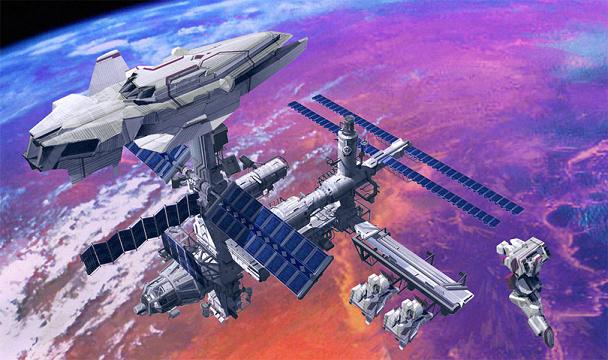 As
humanity takes the leap into the
heavens... the ingenuity, diversity and creativity of a broader cross
section of the human population, exponentially increases the evolutionary
possibilities available to us as a space-faring species.
As
humanity takes the leap into the
heavens... the ingenuity, diversity and creativity of a broader cross
section of the human population, exponentially increases the evolutionary
possibilities available to us as a space-faring species.
 backs of the intellectuals so they could
disagree on material things with the church and without the fear of
being burned at the stake. So that ended that, but it did cause, for
four hundred years, science to consider consciousness and mind a
subject for philosophy and religion and not a subject for science.
backs of the intellectuals so they could
disagree on material things with the church and without the fear of
being burned at the stake. So that ended that, but it did cause, for
four hundred years, science to consider consciousness and mind a
subject for philosophy and religion and not a subject for science. the Zen
Buddhist expression:
the Zen
Buddhist expression:

