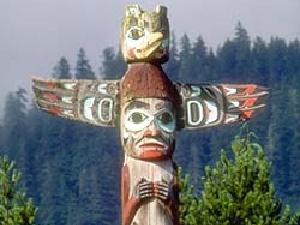
All around our small planet,
Native & indigenous traditions have been a rich source of spiritual
inspiration. They serve as "Arks" or repositories for earth's rich past.
They provide perspective on the importance of balance with the natural
world. The myths and archetypical characters that populate them
exemplify a path of harmony that humans can walk with all the winged,
finned and four-legged earthlings.
Find herein examples of such
myths, as well as important resources to continue the path...
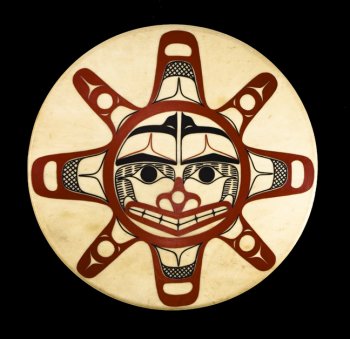
Item: The
Trickster
"In Native American
mythology there are (spirit) figures known as
tricksters...
individuals whose
actions have been attributed to natural phenomenon such as the creation
the earth, the sun, the
advent of fire, and the weather. Early native
shamans and philosophers attributed these beings with human qualities as
a means of likening their actions to the same passions that govern human
thought. Having their origins in the oral tradition of early Indian
tribes, these tricksters have evolved into powerful symbols. The
transformative powers of the trickster make such an entity transcend the
physical and metaphysical world."
"The most common
manifestation of the trickster is the raven. There are many stories
attributed to this trickster and he is seen throughout northwestern
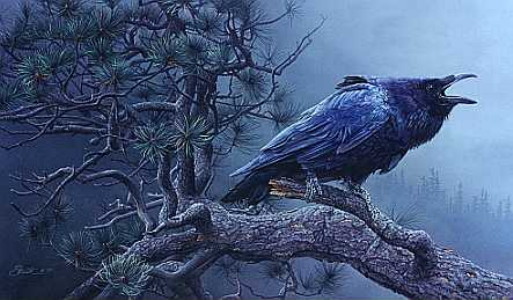 native mythology as a figure of great import. Nearly all of the tribes
of the American northwest have an oral tradition about the raven and how
his actions have affected human development. The Inuit of Alaska have a
creation story that tells of a great struggle between Raven and a sea
creature of indeterminable size and scope. Using his harpoon, Raven
captured the creature and it thus became the land.
native mythology as a figure of great import. Nearly all of the tribes
of the American northwest have an oral tradition about the raven and how
his actions have affected human development. The Inuit of Alaska have a
creation story that tells of a great struggle between Raven and a sea
creature of indeterminable size and scope. Using his harpoon, Raven
captured the creature and it thus became the land.
In another story,
Raven brings sunlight to a dark world. The Tsimshian of British Columbia
and Alaska were given light by the raven, who tricked a tribal chief
along the Nass River. The chief kept the light in a box in his lodging
and the raven conceived an intricate scheme to obtain it. Raven
transformed himself into a spruce needle and then fell from the sky into
a cup of water that the chief’s daughter was drinking and impregnated
her. Born into human form, Raven stole the chief’s box and then
transformed into his original shape. As he flew away with his prize, he
encountered a group of fishermen.
Hungry, Raven asked the group if he could
have some of their catch. When they refused, he flew off and released
the daylight. In this story, early native oral tradition blends both the
trickster with the transformer figure, another important aspect of
native religious development; one often seen with trickster stories."
- Jeffrey R Gudzune
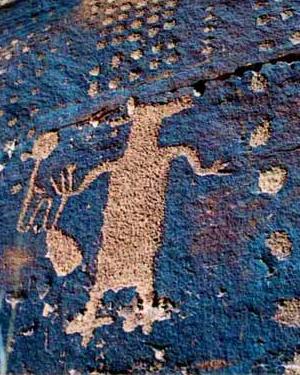
Petroglyph of the trickster in the form of "coyote"
Item: Turtle Island Creation Myth
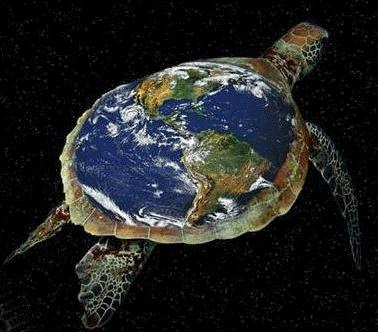
Long before the world was created there was an
island, floating in the sky, upon which the Sky People lived. They lived
quietly and happily. No one ever died or was born or experienced
sadness. However one day one of the Sky Women realized she was going to
give birth to twins. She told her husband, who flew into a rage. In the
center of the island there was a tree which gave light to the entire
island since the sun hadn't been created yet. He tore up this tree,
creating a huge hole in the middle of the island. Curiously, the woman
peered into the hole. Far below she could see the waters that covered
the earth. At that moment her husband pushed her. She fell through the
hole, tumbling towards the waters below.
Water animals already
existed on the earth, so far below the floating island two
birds saw the Sky Woman fall. Just before she reached the
waters they caught her on their backs and brought her to the
other animals.
Determined to help the woman they dove into
the water to get mud from the bottom of the seas. One after another the
animals tried and failed. Finally, Little Toad tried and when he
reappeared his mouth was full of mud. The animals took it and spread it
on the back of Big Turtle. The mud began to grow and grow and grow until
it became the size of North America.
Then the woman stepped onto the land. She
sprinkled dust into the air and created stars. Then she created the
moon and sun. The Sky Woman gave birth to twin sons. She named one
Sapling. He grew to be kind and gentle. She named the other Flint
and his heart was as cold as his name. They grew quickly and began
filling the earth with their creations. Sapling created what is
good. He made animals that are useful to humans. He made rivers that
went two ways and into these he put fish without bones. He made
plants that people could eat easily. If he was able to do all the
work himself there would be no suffering.
Flint destroyed much of Sapling's work and
created all that is bad. He made the rivers flow only in one
direction. He put bones in fish and thorns on berry bushes. He
created winter, but Sapling gave it life so that it could move to
give way to Spring. He created monsters which his brother drove
beneath the Earth.
Eventually Sapling and Flint decided to
fight till one conquered the other. Neither was able to win at
first, but finally Flint was beaten. Because he was a god Flint
could not die, so he was forced to live on Big Turtle's back.
Occasionally his anger is felt in the form of a volcano.
The Iroquois people hold a great respect for
all animals. This is mirrored in their creation myth by the role the
animals play. Without the animals' help the Sky Woman may have sunk
to the bottom of the sea and earth may not have been created.
Ayahuasquero vs.
Curandero
There is much
confusion and misinformation in the Psychedelic West concerning
the different types of Amazonian shamans. This is especially true in regards
to ayahuasca shamans. This confusion is largely around the difference
between the “ayahuasquero” and “curandero.” In their shamanic pursuits, many
westerners are looking for a shaman that works with ayahuasca and therefore
end up drinking with an ayahuasquero. An ayahuasquero is simply someone who
has considerable knowledge of the ways of ayahuasca. They can cook the
brew, set up the space, serve the ayahuasca, sing icarros, and run the
ceremony. They generally are NOT healers.
A curandero, as the name implies, cures people. A curandero has a large
toolbox to draw from as the training for a currandero is much more extensive
and varied.
Curanderos do a large number of plant and tree bark dietas (diets).
These dietas form a strong bond between the currandero and the plants
dieted. Those plants become allies, and the plants teach the curandero how
to work with them during ceremony and in healing. A curandero can call on
one of his plant/tree allies to protect the guest, to bring in the medicine,
and help cure a guest.
A curandero
has learned to work with energies/spirits that may be in the guest. If the
spirit or energy is not useful or harmful, the curandero helps the patient
learn to control that energy/spirit so that it does not cause further
negative manifestations in ceremony nor in life. It is also possible that an
outside spirit may try to get into a guest during ceremony. A curandero
protects the guest from these outside spirits. This skill of managing
energies/spirits is particularly important in an ayahuasca ceremony as a
person’s energies open up significantly in this space.
The above is by no means complete. The intent is to educate
western psychonauts about the difference between curranderos and
ayahuasquero. This is due to the significant and increasing interest in
ayahuasca by westerners.
 The Indigenous Path